
Air-Blast Circuit Breaker: Working, Types, Advantages and Applications
Air-Blast Circuit Breaker: Working, Types, Advantages and Applications
Search Description: Learn air-blast circuit breaker working, types, advantages, disadvantages and applications in electrical power systems in simple language.
In electrical power systems, circuit breakers play a very important role in protection. Whenever a fault occurs, very high current can flow through the system. If this fault current is not interrupted quickly, it can damage transformers, generators, busbars, cables and other costly equipment.
An air-blast circuit breaker is one type of circuit breaker that uses compressed air as the arc-quenching medium. Instead of using oil or SF6 gas, it directs a high-pressure air blast across or along the arc path to cool the arc and remove ionized particles.
- What is an Air-Blast Circuit Breaker?
- Why Arc Extinction is Required
- Working Principle
- Advantages
- Disadvantages
- Types of Air-Blast Circuit Breakers
- Axial-Blast Circuit Breaker
- Cross-Blast Circuit Breaker
- Radial-Blast Circuit Breaker
- Applications
- FAQs
What is an Air-Blast Circuit Breaker?
An air-blast circuit breaker is a high-voltage circuit breaker in which high-pressure air is used to extinguish the arc formed between the contacts when the breaker opens. The air blast cools the arc, removes ionized gases and rapidly increases the dielectric strength between the contacts.
In simple words, when the circuit breaker opens during a fault, an electric arc appears between the contacts. A strong blast of compressed air is immediately applied to the arc. This air removes the hot ionized particles and helps the arc disappear quickly.
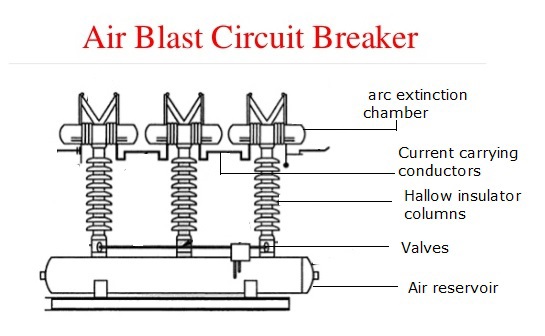
Air-blast circuit breaker used for arc extinction in high-voltage systems
Why Arc Extinction is Important
When circuit breaker contacts separate under fault conditions, the current does not stop immediately. Due to ionization of the medium between the contacts, an arc is formed. This arc allows current to continue flowing for a short time.
If the arc is not extinguished quickly, it may cause:
- Burning of circuit breaker contacts
- Damage to insulation
- Excessive heat generation
- Fire risk in some breaker types
- Failure of power system protection
Working Principle of Air-Blast Circuit Breaker
The working principle of an air-blast circuit breaker is based on using compressed air to cool and deionize the arc path. The breaker has contacts, an arcing chamber, an air reservoir and an air valve.
Under normal operating conditions, the contacts remain closed and current flows through the circuit. When a fault occurs, the relay sends a trip signal to the breaker mechanism. The contacts start separating, and an arc is formed between them.
At the same time, the air valve opens and high-pressure air from the reservoir enters the arcing chamber. This air blast cools the arc and sweeps away the ionized particles. As a result, the dielectric strength between the contacts increases rapidly and the arc is extinguished.
Step-by-Step Working
- Fault occurs in the power system.
- Protective relay detects the fault and sends a trip signal.
- Breaker contacts start separating.
- An arc is produced between fixed and moving contacts.
- High-pressure air blast enters the arcing chamber.
- The air blast cools and deionizes the arc path.
- The arc is extinguished and current flow is interrupted.
Advantages of Air-Blast Circuit Breaker
Air-blast circuit breakers have several advantages compared with oil circuit breakers:
- No fire risk: Since air is used instead of oil, the risk of fire is eliminated.
- Clean operation: Arcing products are removed by the air blast, so there is no oil contamination.
- Fast arc extinction: Dielectric strength builds up quickly between contacts.
- Less contact burning: Arcing time is short, so contact damage is reduced.
- Suitable for frequent operation: Because arc energy is low, it can be used where frequent switching is required.
- Independent arc-quenching energy: The energy for arc extinction comes from compressed air, not from the fault current itself.
Disadvantages of Air-Blast Circuit Breaker
Although air-blast circuit breakers are useful, they also have some limitations:
- Air has lower arc-quenching capability compared with SF6 and vacuum.
- The breaker is sensitive to the rate of rise of restriking voltage.
- A compressor plant is required to supply high-pressure air.
- Maintenance of air compressor and air system is necessary.
- The operation can be noisy compared with vacuum or SF6 circuit breakers.
Types of Air-Blast Circuit Breakers
Depending on the direction of air blast with respect to the arc, air-blast circuit breakers are classified into three main types:
| Type | Direction of Air Blast | Main Feature |
|---|---|---|
| Axial-Blast Circuit Breaker | Along the arc path | Air flows in the same direction as the arc |
| Cross-Blast Circuit Breaker | At right angle to the arc | Air pushes the arc into arc splitters |
| Radial-Blast Circuit Breaker | Radially outward | Air moves outward from the arc region |
1. Axial-Blast Air Circuit Breaker
In an axial-blast air circuit breaker, the air blast is directed along the arc path. The fixed and moving contacts remain closed under normal conditions due to spring pressure. The air reservoir is connected to the arcing chamber through an air valve.
When a fault occurs, the tripping mechanism opens the air valve. High-pressure air enters the arcing chamber and pushes the moving contact away. An arc is formed between the contacts, but the air blast flows along the arc and removes the ionized gases.
Due to this action, the arc is extinguished and current flow is interrupted. In this type, the contact gap required for interruption is usually small, so an isolating switch is often used to provide proper insulation clearance after interruption.

Axial-blast air circuit breaker
2. Cross-Blast Air Circuit Breaker
In a cross-blast air circuit breaker, the air blast is directed at right angles to the arc path. When the moving contact separates from the fixed contact, an arc is produced between them.
The high-pressure cross blast pushes the arc into an arc chute. The arc chute contains arc splitters and baffles. Arc splitters increase the arc length, while baffles improve cooling. This increases arc resistance and helps extinguish the arc quickly.
One important advantage of the cross-blast type is that the final contact gap can be large enough to provide normal insulation clearance. Therefore, a separate series isolating switch is generally not required.

Cross-blast air circuit breaker
3. Radial-Blast Air Circuit Breaker
In a radial-blast circuit breaker, the air blast is directed radially around the arc. This helps in removing ionized particles from the arc region and increases dielectric strength between contacts.
This type is less commonly discussed than axial and cross-blast types, but the basic purpose remains the same: to cool the arc, deionize the path and interrupt the fault current safely.
Applications of Air-Blast Circuit Breakers
Air-blast circuit breakers are mainly used in high-voltage power systems where fast interruption and safe arc extinction are required. They are suitable for:
- High-voltage substations
- Transmission systems
- Industrial power networks
- Systems requiring frequent switching
- Applications where oil-based breakers are not preferred
Air-Blast Circuit Breaker vs Oil Circuit Breaker
| Point | Air-Blast Circuit Breaker | Oil Circuit Breaker |
|---|---|---|
| Arc medium | Compressed air | Transformer oil |
| Fire risk | No fire risk | Fire risk exists |
| Maintenance | Compressor maintenance required | Oil testing and replacement required |
| Arc products | Removed by air blast | Remain in oil and reduce oil quality |
| Operation | Fast operation | Comparatively slower |
Important Points for Students
- Air-blast circuit breakers use compressed air for arc extinction.
- They are safer than oil breakers from a fire-risk point of view.
- They require a compressor plant for high-pressure air.
- They are classified as axial-blast, cross-blast and radial-blast types.
- They are useful in high-voltage systems and frequent switching applications.
Frequently Asked Questions
What is an air-blast circuit breaker?
An air-blast circuit breaker is a circuit breaker that uses high-pressure compressed air to extinguish the arc formed during circuit interruption.
Why is compressed air used in air-blast circuit breakers?
Compressed air cools the arc, removes ionized particles and increases dielectric strength between contacts, helping to stop the current flow safely.
What are the types of air-blast circuit breakers?
The main types are axial-blast, cross-blast and radial-blast circuit breakers.
What is the main advantage of an air-blast circuit breaker?
The main advantage is fast arc extinction without the fire risk associated with oil circuit breakers.
What is the main disadvantage of an air-blast circuit breaker?
The main disadvantage is that it requires a compressor plant and regular maintenance of the compressed-air system.
Where are air-blast circuit breakers used?
They are used in high-voltage substations, transmission systems and industrial power networks where fast interruption is required.
Conclusion
Air-blast circuit breakers are important protective devices used in high-voltage electrical power systems. They use high-pressure air to extinguish the arc produced during fault interruption. Because they do not use oil, they reduce fire risk and provide fast arc extinction.
Although modern systems widely use SF6 and vacuum circuit breakers, air-blast circuit breakers remain an important topic for electrical engineering students and power system professionals. Understanding their working, advantages, disadvantages and types helps build a strong foundation in switchgear and protection.


 Posts
Posts


Nice blog on Industrial Engineering Knowledge eaton mcb gives good performance on all Electricals.
ReplyDelete